Targeted Messaging for Plant-Based Diet Change
An evidence-based guide for UK communicators
What this is
We created this guide based on extensive public opinion research we’ve been conducting to understand how people relate to food, and their openness to plant-based diet change.
Use this guide to:
1. Identify your audience
2. Understand your audience
3. Focus your messages on their mindsets and goals
Headline findings
Greater meat reduction may be achieved by moving away from meat language and culture to describe plant-based food products.
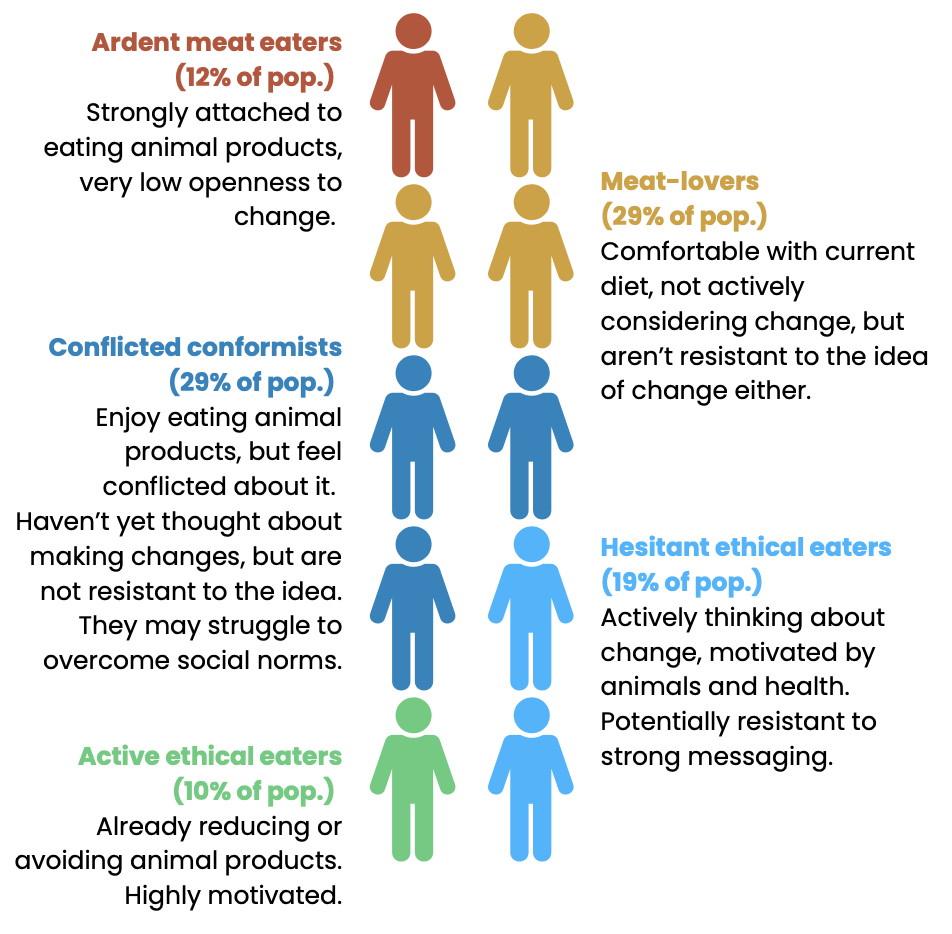
- The most valuable audiences are already within reach. Hesitant ethical eaters and conflicted conformists together represent nearly half of the UK population and show meaningful openness to change. Focusing effort here rather than spending it across all five segments is where comms investment will go furthest.
- Ethical and environmental framing is an asset, not a risk. The audiences most likely to buy new meat are already motivated by values around animals and the environment. Messaging that speaks directly to those values (rather than defaulting to meat mimicry or indulgence) connects more effectively with the people most primed to act.
- Social norms are a lever, not just a barrier. Conflicted conformists are strongly influenced by what others around them are doing. Showing that plant-based eating is becoming more mainstream and socially accepted is one of the most effective ways to move this group.
- Different audiences need different messages – and that’s an opportunity. What motivates one group can put another off. But knowing which segment you’re talking to means every message can be tailored to land rather than backfire. Segmentation turns a communications risk into a strategic advantage.
Why it matters
Reaching and moving audiences is one of the animal freedom movement’s persistent challenges. Our latest segmentation research raised questions that invite further perspective taking: are we speaking to everyone we could be? And are our messages landing with our allies, pushing them forward to action, and not inadvertently holding them back?
This research starts from a different premise: that dietary changes are shaped by different values, motivations and identities, and that messaging is more likely to shift behaviour when it’s aligned with where people actually are, not where we’d like them to be.
Based on a study of over 3,000 UK adults across two studies, we identified five psychologically distinct audience segments based on people’s beliefs, habits and openness to change around food and animal products. We then tested which kinds of messages resonated with each segment – and which ones triggered pushback instead.
What emerged is a practical tool for the movement; a way to quickly identify whether you’re talking to someone resistant, conflicted or already receptive – and to adjust your framing and ask accordingly. Our findings aren’t the answer, but a starting point for a more clear picture of who the audience is, what moves them, and where the real opportunity lies.
The full report includes audience profiles, messaging implications, and the data behind each finding. Download it here.

How you could use this guide
Campaign planning
To identify which segments you are primarily trying to reach and select messages that are more likely to resonate with them.
Message testing
To sense check if a draft message is suited to your chosen audience segment before a wider rollout.
Training
To give teams a shared language for talking about audiences and avoiding the one-size-fits-all assumptions.
Outreach and conversations
To quickly orient yourself in one-to-one or small group interactions and adjust tone, framing and emphasis accordingly.
Opinion piece: Do we need ‘something else’?
“Mark, I can eat meat, fake meat, or something else. Give me meat or something else, I’m not going to eat your fake meat.”
Mark Westcombe‘s sister is not about to go vegan. But she’s been buying VFC® nuggets, vegan shrimp, and kebab meat for years … with strong opinions about why.
In his first light-hearted (but serious) opinion piece, Mark uses a qualitative study of one to explore what ‘meat-lovers’ are actually looking for, what puts them off, and why the ‘something else’ category might be a bigger opportunity than ‘new meat’ for this segment.
Could this challenge assumptions about the audiences you’re trying to move?