Choosing words for
animal freedom
A practical guide for animal freedom communicators

What this is
The words we choose shape how people see an issue, how they understand it, and whether they act.
This guide draws on research in psychology, public opinion and movement strategy to help you use language more intentionally. It’s a guide, not gospel: a set of options to expand your comms toolbox.
Use this guide to:
1. Spot words that distance people from other animals or hide harm
2. Swap in language that builds connection
3. Frame your messages around shared values and a hopeful vision
Seven top tips
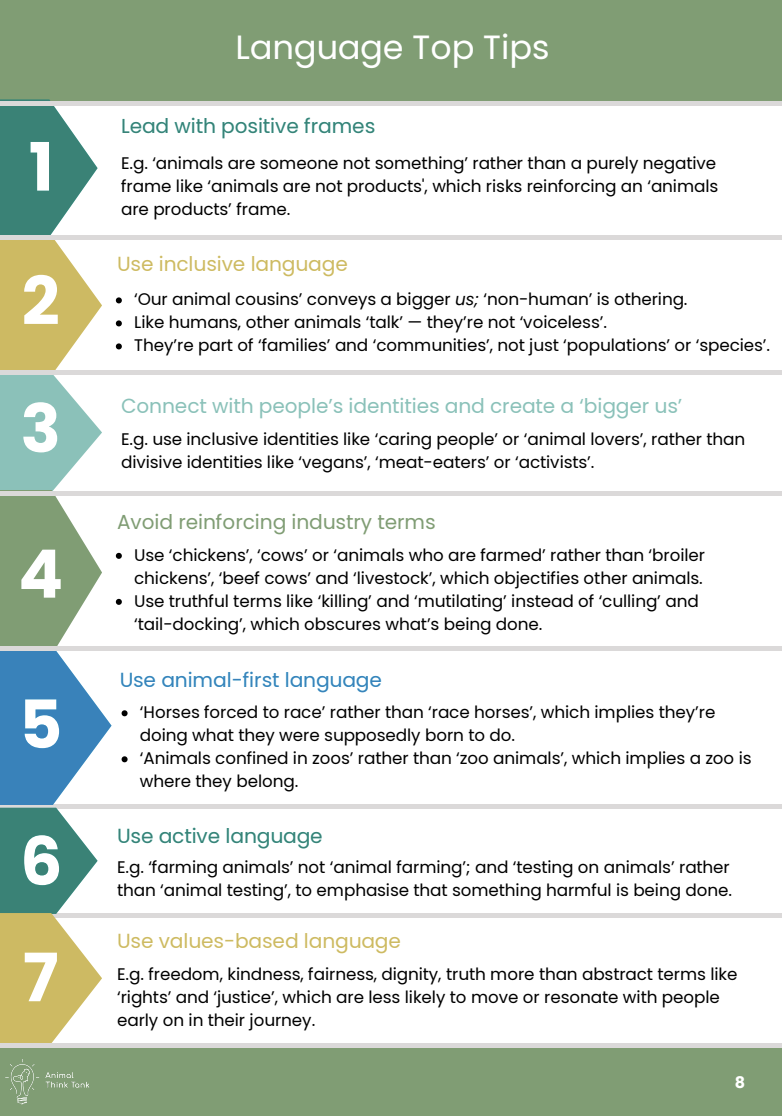
Paint a vision, not just a problem.
- Lead with what we’re for. Saying what something isn’t can backfire, because people tend to remember the idea you’re arguing against. ‘Animals are someone’ lands better than ‘animals are not products’.
- Use language that connects. ‘Other animals’ rather than ‘non-human animals’, ‘families’ and ‘communities’ rather than ‘populations’.
- Invite people in. Labels like ‘vegan’, ‘meat-eaters’ and ‘activists’ can divide; instead ‘people who care about animals’ lets more people see themselves in the message.
- Don’t borrow industry terms. Words like ‘livestock’, ‘culling’, and ‘tail docking’ hide what’s happening; ‘animals who are farmed’, ‘killing’ and ‘cutting off tails’ don’t. Where possible, avoid using industry words that attempt to normalise harm.
- Put animals first, and make the harm visible. ‘Horses forced to race’, not ‘racehorses’; ‘testing on animals’ rather than ‘animal testing’.
- Lead with shared values. Freedom, kindness, fairness, and dignity tend to move people further than abstract terms like ‘rights’ and ‘justice’.
Why it matters
Like culture, language is always evolving. Across social justice movements, changing the way people speak has been a key part of changing the way people think. Terms like ‘chairman‘ have become ‘chair‘ or ‘chairperson‘, highlighting that leadership isn’t gender-specific. Shifts like this seem small, but they help reshape norms and challenge assumptions.
The same as true for how we talk about animals. Something as simple as replacing ‘it‘ with ‘he‘, ‘she‘ or ‘they‘ can provoke a shift in thinking – and, if adopted widely, a broader cultural shift towards connection and respect.
But there’s no one audience. Everyone is at a different point in their journey: in their empathy towards other animals, their attitudes and beliefs, and their behaviours. Someone further along may be open to more progressive language, while someone further back may be more resistant. Our goal is to use language that encourages new ways of relating to other animals, and nudges people further along their journey in a way that doesn’t jar.
How you could use this guide
Writing and editing
To check drafts for words that create distance, hide harm or divide people – and find alternatives.
Campaign planning
To agree shared language across your team before every launch, so every message and story is built on the same big idea.
Training
To give staff and volunteers a common vocabulary, and a way to explain why word choices matter.
Working with partners
To give specific, constructive feedback on shared materials, with a common reference point.
From our Substack: Swap harmful terms for truthful ones
“Are you a chicken?” “Don’t be a sheep.” “What a greedy pig.”
Everyday phrases like these quietly reinforce speciesism. But what about the language we use as a movement? Could some of our own words be reinforcing the frames we’re trying to challenge?
This newsletter takes a closer look, with five practical shifts and examples you can use straight away.
Find more resources
Feeling stuck on how to use these ideas in your comms? Drop us a line, we’d love to support.